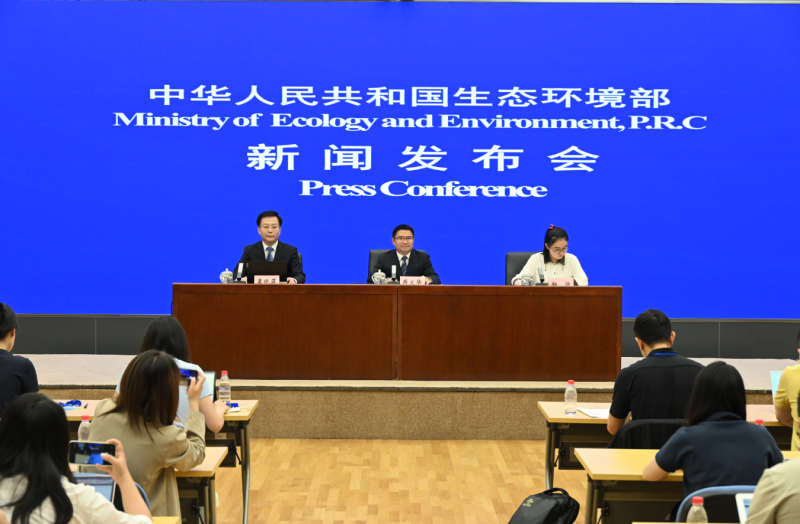
National surface water quality in China achieved its best-ever results in 2025. Jiang Huohua, director of the Department of Water Ecology and Environment at the Ministry of Ecology and Environment, said at a regular press conference on June 25 that the proportion of water rated Grade III or above reached 91.4%, while the proportion of sections rated below Grade V was 0.6%. From January to May this year, based on the latest data from the 15th Five-Year Plan national monitoring network, the share of Grade III or above was 88.0%, up 2.4 percentage points year on year. The compliance rate of ecological flows in key rivers and lakes exceeded 90%, a cumulative 8,600 kilometers of river and lake buffer zones were restored, and the number of Yangtze finless porpoises recovered to 1,426.
Improvement was particularly notable in the Yangtze Economic Belt, where the share of good-quality water rose from 67% in 2015 to 96.5%, an increase of nearly 30 percentage points. The main stream of the Yangtze has maintained Class II water quality for six consecutive years. The reduction in total phosphorus and ammonia nitrogen in the basin is comparable to the improvement of the Rhine River in Europe over nearly 30 years. At the same time, the region's GDP as a share of national total increased from 42.2% to 47.3%, and per capita disposable income of residents rose from 23,000 yuan to 44,000 yuan. The main stream of the Yellow River has remained at Class II for four straight years, and its major tributaries have largely eliminated Class V water. From January to May, the share of Grade III or above in the Yangtze Economic Belt and the Yellow River basin was 90.9% and 88.0%, respectively, up 0.1 and 5.6 percentage points year on year.
Jiang attributed the progress to joint efforts across regions and departments, treating rivers and lakes one by one. In terms of water environment treatment, over 590,000 kilometers of river and lake shorelines were inspected, and 491,000 outfalls were identified; 95% of the key tributaries and lakes in seven major river basins had been rectified. More than 1,900 industrial parks in Yangtze and Yellow River provinces built over 2,800 centralized wastewater treatment facilities, and over 4,100 problems were rectified. The black-odorous water bodies in cities at or above prefecture level were basically eliminated, and over 90% of such bodies in 397 county-level cities were tackled. In terms of water ecological protection and restoration, the ministry formulated scoring rules for water ecological assessment in the Yangtze basin, monitored 50 water bodies, established a joint provincial-ministerial working group for plateau lakes, and guided the construction of water source conservation areas and buffer zones.
Water environment risk prevention focused on flood-season water quality, lake reservoir algal blooms, and drinking water safety. Twenty-nine key lakes and reservoirs, including Taihu, Chaohu, and Dianchi, were placed under strict oversight, and emergency response plans for sudden water pollution incidents were prepared for 2,575 key rivers. In addition, 66 national discharge standards for water pollutants have been issued, and 24 provinces have established 35 trans-provincial horizontal ecological compensation mechanisms.
Jiang acknowledged that the inflection point from quantitative to qualitative improvement has not yet arrived, and some micro water bodies near residents are still unsatisfactory. Next steps involve implementing the 15th Five-Year Plan for major river basins to create an integrated governance system, deepening landmark campaigns such as Yangtze conservation, Yellow River ecological protection, and county-level black-odorous water body treatment, advancing central-government-funded beautiful river and lake projects, and launching a special action plan to protect water bodies near communities.
Local practices have yielded diverse benefits. In Guangzhou, Liede Creek adopted nature-based solutions to reach Class III. In Zhongshan, Anfuyong Creek turned from black and odorous to clean after addressing issues raised by central ecological and environmental inspections, enabling dragon boat races and a coffee·music festival that attracted 18,000 visitors in two days, driving spending of over 2 million yuan. Shanghai's Suzhou Creek implemented coordinated governance of the main stream and tributaries, hosting dragon boat races and other waterfront events, allowing residents to enjoy the water up close and sharing the dividends of ecological management.