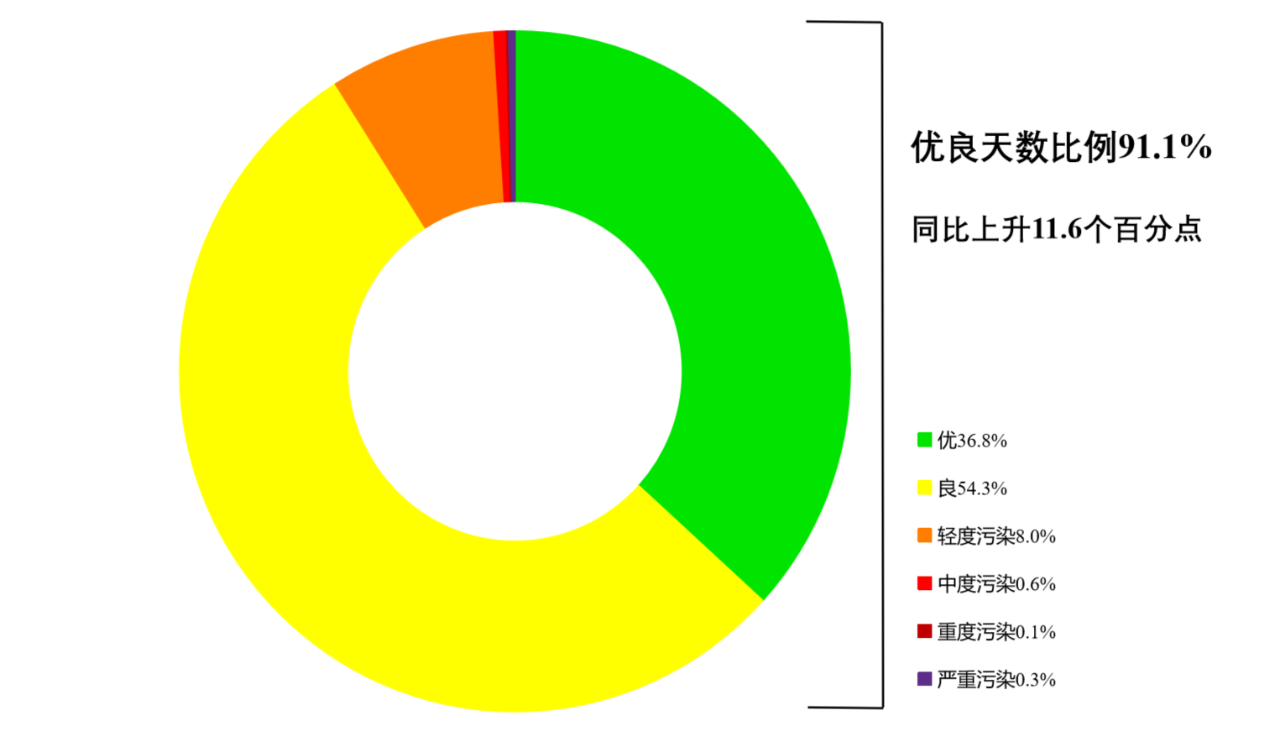
Air quality in 339 prefecture-level and above cities in China showed improvement in May 2026. The proportion of days with good air quality reached 91.1%, an increase of 11.6 percentage points compared to the same period last year. Meanwhile, the proportion of days with heavy or worse pollution fell to 0.4%, a year-on-year drop of 0.6 percentage points. The average proportion of days exceeding standards due to sand and dust weather was 2.3%, of which heavy or worse pollution days accounted for 0.4 percentage points.
Concentrations of major pollutants generally declined. The average PM2.5 concentration was 19.1 µg/m³, a year-on-year decrease of 21.7%. The average PM10 concentration was 37 µg/m³, down 19.6%. The average O3 concentration was 141 µg/m³, down 9.6%. SO2 and CO average concentrations were 7 µg/m³ and 0.7 mg/m³, respectively, both unchanged from the previous year. The average NO2 concentration was 13 µg/m³, down 13.3%.
Among key regions, the Beijing-Tianjin-Hebei and surrounding areas ('2+36' cities) recorded an average PM2.5 concentration of 22.9 µg/m³, down 31.2% year-on-year, and an average O3 concentration of 168 µg/m³, down 15.6%. The proportion of days with good air quality in this region was 83.4%, up 29.6 percentage points, with no days of heavy or worse pollution. No days exceeding standards due to sand and dust weather occurred. In Beijing, the PM2.5 concentration was 23.6 µg/m³, down 20.3%; the O3 concentration was 191 µg/m³, down 9.0%; and the good air quality days proportion was 77.4%, up 19.3 percentage points. There were no heavy or worse pollution days nor sand-weather-related exceedances.
In the Yangtze River Delta region, the 31 cities had an average PM2.5 concentration of 21.4 µg/m³, down 27.2%, and an average O3 concentration of 167 µg/m³, down 8.7%. The good air quality days proportion was 83.3%, up 19.9 percentage points, and no heavy or worse pollution days or sand-weather-related exceedances were recorded.
The Fen-Wei Plain's 13 cities saw an average PM2.5 concentration of 21.3 µg/m³, down 25.5%, and an average O3 concentration of 157 µg/m³, down 13.3%. The good air quality days proportion reached 88.1%, up 30.8 percentage points. While there were no heavy or worse pollution days, sand and dust weather caused 0.5% of days to exceed standards, none of which were heavy or worse pollution.
Additionally, the Ministry of Ecology and Environment released the comprehensive air quality index and PM2.5 concentration data for 168 key cities for May and the first five months of 2026.